


In June 2026, Prague will become an important international meeting point for the digital publishing sector, bringing together publishers, developers, researchers, accessibility experts, technology providers, cultural professionals, and innovators for a week dedicated to the future of books, reading, and digital transformation.
The 10th Digital Publishing Summit, organised by EDRLab, will take place on Monday, 8 June, and Tuesday, 9 June 2026, in the exceptional setting of the Museum of Decorative Arts in Prague. The venue, situated at the intersection of cultural heritage, design, and innovation, offers a fitting environment for a conference focused on the transformation of the book industry in the digital age.
Each year, the Digital Publishing Summit serves as an essential meeting place for the global digital book community, gathering more than 120 experts to discuss the latest challenges and innovations in how digital content is produced, distributed, protected, discovered, and read. The 2026 edition will offer a broad and highly relevant programme addressing some of the key questions currently shaping the publishing ecosystem: accessibility, interoperability, digital rights management, artificial intelligence, discoverability, subscription models, standards, reading technologies, and the evolving needs of readers.
The Summit will open with welcoming remarks by Arnaud Robert, President of EDRLab. With his extensive background in publishing, legal affairs, institutional relations, and copyright frameworks, Robert will introduce a programme that connects technological innovation with the broader legal, cultural, and social responsibilities of the publishing sector.
The first day of the Summit will focus on large-scale digital transformation, inclusive reading experiences, and new publishing models. The programme will begin with a session on Scaling Digital Textbooks Nationwide, presenting Brazil’s National Textbook Program and its digital transformation towards accessible, interactive, and intelligent textbooks for millions of students. This will be followed by a case study on Implementing Universal Publishing, showing how accessibility can become a systemic editorial principle rather than an isolated technical requirement.
A strong emphasis will also be placed on accessibility and inclusive design. Sessions will explore the co-design of reading experiences for low-literacy users, fixed-layout publications in the context of the European Accessibility Act, and the evaluation of accessibility metadata in e-books. These discussions will be particularly relevant for publishers, libraries, platforms, and technology providers working to ensure that digital reading environments are usable and meaningful for all readers, including readers with disabilities, dyslexia, low literacy, or other reading barriers.
The programme will also address the commercial and infrastructural challenges of contemporary publishing. The session The Death of the “Franken-stack” will examine how fragmented systems for print, digital delivery, and tax compliance can limit publishers’ growth, while the session How discoverability works today will look at the increasing difficulty of making books visible in a saturated digital environment. The discussion will highlight the importance of metadata, accessibility, formats, language availability, verification, and artificial intelligence in helping valuable content reach readers.
Artificial intelligence will be another important topic of the Summit. The session Amlet as the Trust Layer for the Creative AI Economy will address how publishers and creators can signal permissions, manage rights, and provide lawful access to content in the context of AI training and text and data mining. The presentation will place particular emphasis on open standards, transparency, and new infrastructures that can support a more responsible relationship between the creative and AI sectors.
The first day will also include a presentation by Michael Tamblyn, CEO of Rakuten Kobo, on Kobo Plus and the Evolution of Subscription Models in Global Digital Publishing. This session will examine how subscription models are changing reader engagement, content access, licensing, and international market development. The day will conclude with a roundtable on supporting publishers’ digital journeys, sponsor presentations, lightning talks, and a cocktail reception.
The second day of the Digital Publishing Summit will focus more specifically on standards, reading technologies, and the EDRLab ecosystem. The morning will include an Update on Standards, presented by key figures in the field, including Laurent Le Meur, Hadrien Gardeur, Gregorio Pellegrino, and Gautier Chomel. This will be followed by a session on LCP Checkpoint, offering an overview of the global adoption of Readium LCP, an interoperable DRM standard designed to protect e-books, audiobooks, and PDFs while preserving accessibility and user privacy.
Further sessions will present updates on Thorium Reader for Windows, Mac, Linux, iOS, and web environments, as well as practical examples of organisations building on EDRLab technologies. These include presentations on inkBOOK Freebooks and OPDS2, the Polish Czytnix platform, Ellibs’ experience with Readium Toolkits, LCP, OPDS feeds and Thorium Web, and the development of interoperable ecosystems for scholarly digital publishing. The Summit will conclude with closing remarks, followed by the EDRLab Annual General Meeting on Tuesday afternoon.
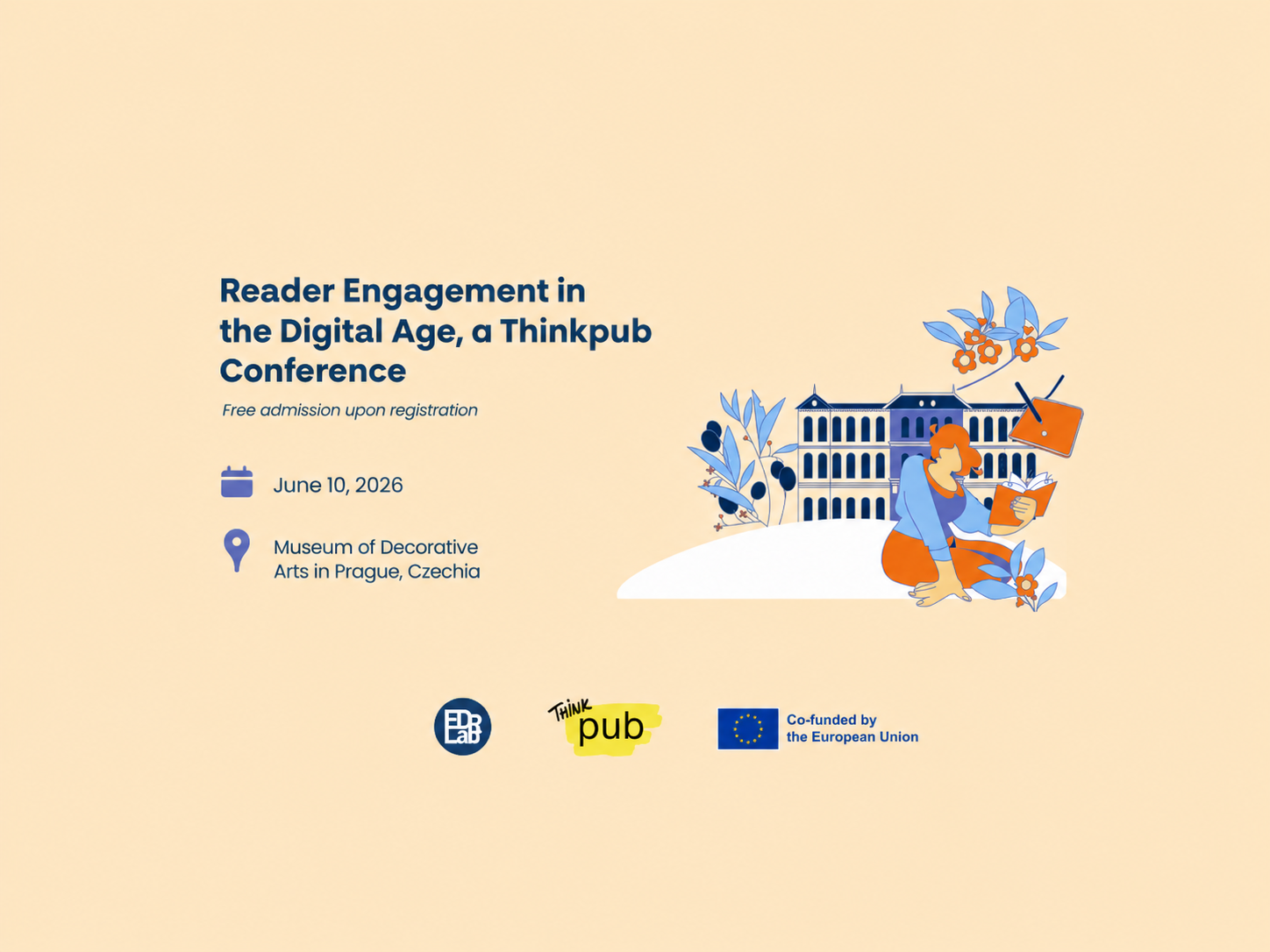
The programme will continue on Wednesday, 10 June 2026, with the ThinkPub Conference “Reader Engagement in the Digital Age”, also taking place in Prague. Organised as part of the European project ThinkPub, the conference will be free upon registration and will offer a focused reflection on how people read today, what readers expect from digital environments, and how the very idea of the book is being reshaped by technological, cultural, and social change.
The ThinkPub Conference will provide a high-level overview of the intellectual, technical, and practical components that define the contemporary digital reading ecosystem. It will explore the changing nature of reading in a time when books are no longer experienced only as printed objects or static digital files, but increasingly through platforms, devices, apps, audio formats, social reading environments, AI-supported tools, and interactive digital services.
The conference will open with forewords by Alma Čaušević Klemenčič, ThinkPub project leader, followed by the session We need to talk about reading by Virginie Clayssen. Her contribution will address the new phase of reading’s digitisation, in which automation and artificial intelligence are beginning to change not only how texts are accessed, but also where cognitive work takes place and what it means to read when machines can increasingly read alongside humans.
The second keynote, The mindful machine: designing digital reading for deeper engagement, will be delivered by Michael Tamblyn. The session will examine how digital platforms can support sustained attention, deeper comprehension, and a richer relationship with books. Drawing on the example of Rakuten Kobo’s e-reading ecosystem, the talk will explore how hardware, software, personalisation, annotation, reading communities, and insights from cognitive science can help digital reading serve readers more thoughtfully.
In the afternoon, Yun J. Inada will present Beyond free and piracy: delivering value in legal Manga platforms, focusing on how legal digital manga platforms can offer readers a stronger and more sustainable alternative to unauthorised scan sites. The session will examine content selection, format adaptation, webtoon models, subscriptions, partnerships with major publishers, and the importance of building legal digital offers that genuinely meet reader expectations.
The programme will also include a presentation by Elena Prat on The reading experience from an academic perspective. Her session will introduce research into how readers experience, interpret, and respond to texts, drawing on fields such as literary studies, history, and cognitive sciences. It will also consider how empirical research into reading, including testimonies, interviews, letters, reviews, and digital corpora, can offer practical insights for publishers and editorial work.
The ThinkPub Conference will conclude with the roundtable Taking care of reading in the digital age, moderated by Virginie Clayssen. Bringing together the day’s speakers, the discussion will address how reading is evolving in a digital environment marked by distraction, new formats, accessibility demands, legal and illegal platforms, audiobooks, social reading, interactive experiences, and artificial intelligence. The central question will be how the publishing sector can care for reading itself — preserving depth, attention, accessibility, pleasure, and meaning while embracing innovation.
Together, the Digital Publishing Summit and the ThinkPub Conference will create a rich and interconnected professional programme in Prague. While the Summit will provide an international overview of the technologies, standards, infrastructures, business models, and accessibility frameworks shaping digital publishing, the ThinkPub Conference will place the reader at the centre of the conversation, asking how digital transformation changes reading habits, expectations, attention, and engagement.
The ThinkPub Conference is scheduled immediately after the Digital Publishing Summit, allowing participants to combine both events in a single professional trip. Attendees registering for the ThinkPub Conference will receive a preferential registration rate for the full two-day Digital Publishing Summit. In addition, EDRLab has secured a special accommodation discount for participants at the Hotel Metropolitan Prague, valid for stays between 1 and 12 June 2026.
With the Digital Publishing Summit, the ThinkPub Conference, the Readium Dev Day, and XML Prague taking place in close succession, Prague will become a temporary European hub for digital publishing, technological exchange, accessibility, reader engagement, and forward-looking conversations about the future of the book. The events will offer participants not only practical knowledge and international networking opportunities, but also a broader reflection on how books, readers, and publishing institutions can continue to evolve in a rapidly changing digital world.
More information and registration
More information about the Digital Publishing Summit 2026, including the full programme, tickets, speakers, and practical details, is available here:
https://www.edrlab.org/events/digital-publishing-summit-2026-program/
More information about the ThinkPub Conference “Reader Engagement in the Digital Age”, including the full programme, speakers, registration, and travel information, is available here:
https://www.edrlab.org/events/thinkpub-conference-reader-engagement-in-the-digital-age-program/