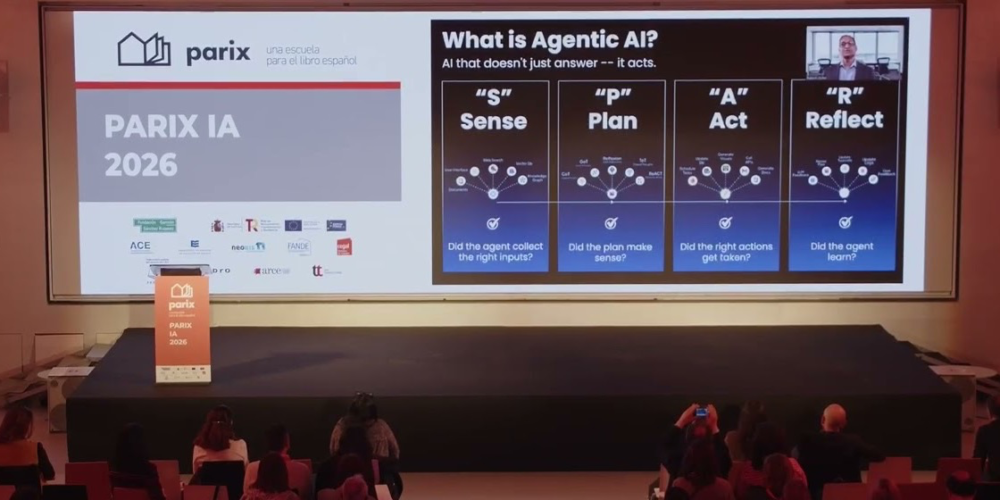
At PARIX IA 2026, held in Madrid on 18 March 2026, Rakesh Gohel examines how agentic artificial intelligence could transform publishing, bookselling and library services. Gohel, an expert in agentic AI and co-author of Agentic Artificial Intelligence, begins by recognising the anxiety, confusion and curiosity surrounding these rapidly developing technologies.
He distinguishes generative AI from agentic AI through a simple analogy. A generative system resembles a highly capable intern who requires specific instructions for every individual task and stops after producing a response. An AI agent can pursue a broader objective independently by moving through four recurring phases: sensing available information, planning an approach, acting through appropriate tools and reflecting on the result.
In publishing, these capabilities could help editors manage large quantities of unsolicited manuscripts. An agent might classify submissions, conduct an initial evaluation and route promising projects to the appropriate team, reducing response times from weeks to hours. The technology could handle repetitive work and information-heavy processes while allowing editors to dedicate more attention to authors, creative development and final publishing decisions.
Gohel also considers applications for libraries and booksellers, including stock monitoring, answering routine reader enquiries and generating personalised recommendations based on individual interests. Such systems could improve book discovery in a manner comparable to personalised music platforms. However, Gohel stresses that AI should complement rather than replace publishing professionals. Machines can process volume and execute workflows, but people retain the judgment, empathy and cultural understanding required to recognise which books and stories genuinely matter to their communities.
Original title: Agentes de IA para el mundo del libro