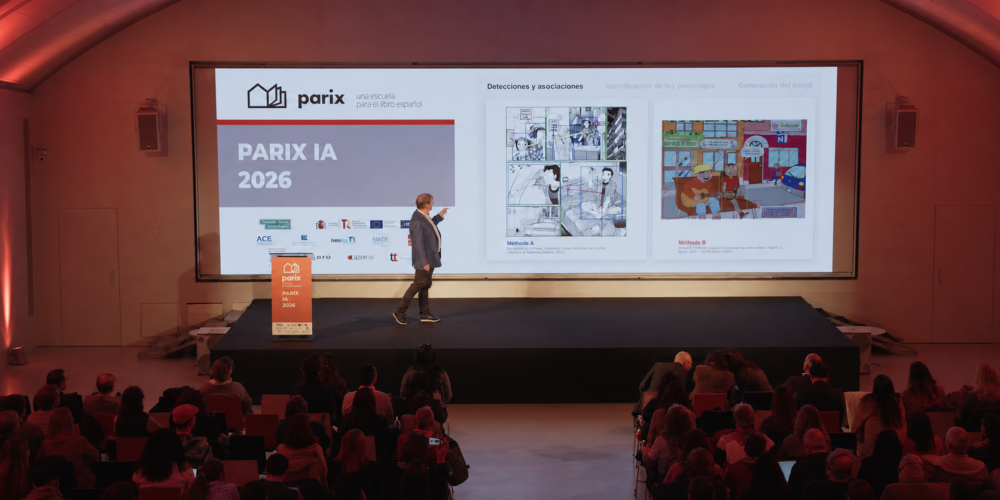
At PARIX IA 2026, held in Madrid on 18 March 2026, Samuel Petit examines how artificial intelligence can make comics accessible to blind and visually impaired readers. Unlike conventional books, comics communicate primarily through images and often contain little text or usable metadata. Producing professional human audio adaptations is expensive, limiting publishers to only one or two accessible titles each year.
Petit describes research conducted by Mangas.io in collaboration with the University of La Rochelle. Its AI tools analyse page geometry, identify characters and onomatopoeia, connect speech balloons to their speakers and track relationships across panels. More advanced challenges include interpreting perspective, recognising the same character throughout a story and understanding the narrative ellipsis—the events readers infer between one panel and the next.
The system uses this structured information to generate a coherent audio script incorporating dialogue, narration, emotion and visual description. It must understand character identities and story arcs without revealing information before it appears in the original work. A demonstration using an Astérix comic compares a human-produced French version with an AI-assisted Spanish adaptation. Human reviewers correct the output, following the team’s rule that anything the system cannot perform reliably should not be automated.
The technology has already reduced production costs approximately twentyfold. This progress is particularly relevant because the European accessibility exemption currently covering comics is expected to end in 2030. Petit also distinguishes a freely interpreted audio adaptation from precise audio description synchronised with the original images. For publishers, AI could make much larger comic catalogues accessible, provided that production includes quality control, editorial supervision and appropriate licensing.
Original title: Visión por computadora aplicada a las imágenes de los libros: últimos avances