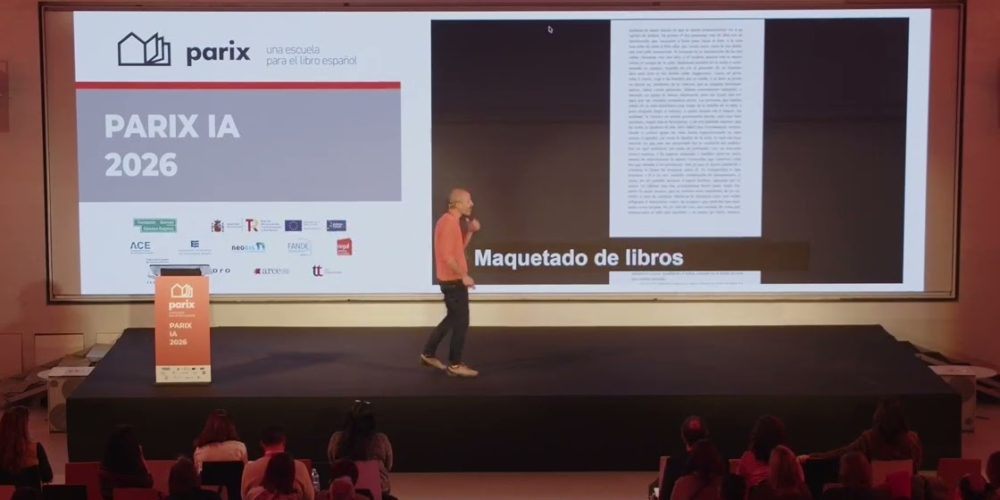
At PARIX IA 2026, held in Madrid on 18 March 2026, Daniel Benchimol presents practical examples of integrating artificial intelligence into publishing workflows. Rather than discussing hypothetical possibilities, the founder and director of Proyecto 451 demonstrates tools that can already navigate websites, analyse documents, operate software and produce finished editorial materials.
Using Claude Cowork, Benchimol shows how an AI agent can research a publisher’s children’s catalogue and create an English-language rights catalogue as a finished PDF. Further examples include auditing hundreds of metadata records, analysing negative reviews of bestselling books, consolidating information from contracts and producing a complete book layout from a manuscript and basic design instructions.
He also demonstrates NotebookLM as a controlled environment for working with selected sources. From a novel, the system can produce reading reports, marketing dossiers, discussion questions, comics and infographics. Publishers can also create specialised notebooks containing classification rules or expert knowledge and then use them to assign accurate categories or develop strategies grounded in those materials. Freepik provides complementary image and video generation workflows.
Benchimol concludes with “vibe coding”: describing a required digital product in ordinary language and allowing AI to build it. This could produce a sales landing page with interactive elements without conventional programming knowledge. His examples show AI moving beyond conversational assistance into direct execution, but effective results still depend on clear objectives, appropriate source material and human review.
Original title: Cómo integrar la IA en la edición de libros: casos reales y herramientas