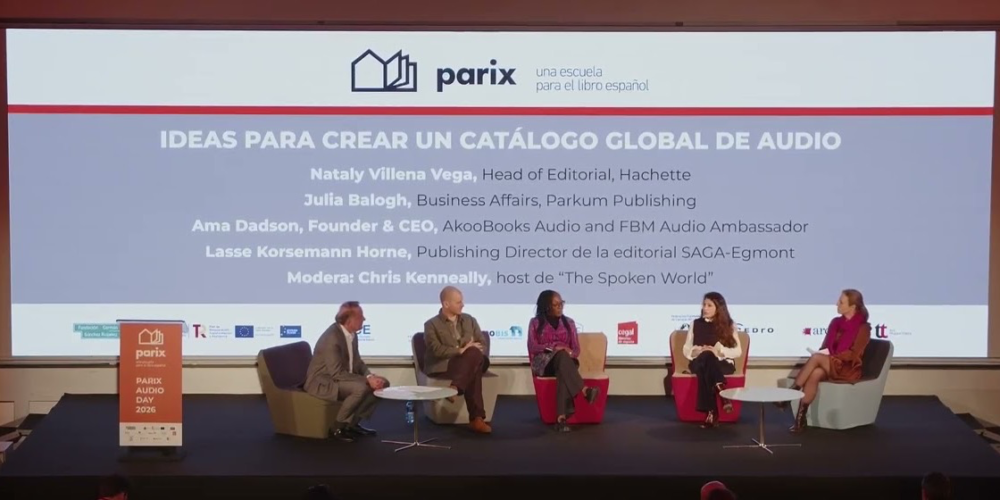
At PARIX Audio Day in Madrid on 19 February 2026, Nataly Villena Vega, Julia Balogh, Ama Dadson and Lasse Korsemann Horne discuss the creation of a genuinely global audio catalogue. Moderated by Chris Kenneally, the panel considers cultural representation, local languages, rights acquisition, technology, distribution and the continuing importance of human narration.
Ama Dadson explains that African audio serves three overlapping audiences: local listeners seeking familiar languages and accents, members of the diaspora reconnecting with home and international audiences discovering new stories. Building the market requires trust with authors and publishers, affordable offline access and stronger representation of African languages, dialects and voices in AI systems. Audio also supports education and access for people unable to use printed books.
Villena Vega describes AI as a support tool for quality control, error detection, metadata and keywords, while editorial selection, casting, narration and marketing remain human responsibilities. French publishers have introduced a label identifying human-made audiobooks so listeners can make informed choices. Balogh and Korsemann Horne similarly favour human voices, noting that experiments with synthetic translation and narration have sometimes failed to meet linguistic and emotional quality standards.
The panel emphasises local talent, local stories and partnerships capable of carrying content between markets. Classics, romance, diaspora communities and immersive reading can travel internationally, but publishers must avoid speculative bidding for rights unsupported by genuine demand. Audio-first productions also require cultural sensitivity: music and dramatic effects may suit children or African oral traditions while proving less effective for adult Scandinavian audiences.
Original title: Ideas para crear un catálogo global de audio