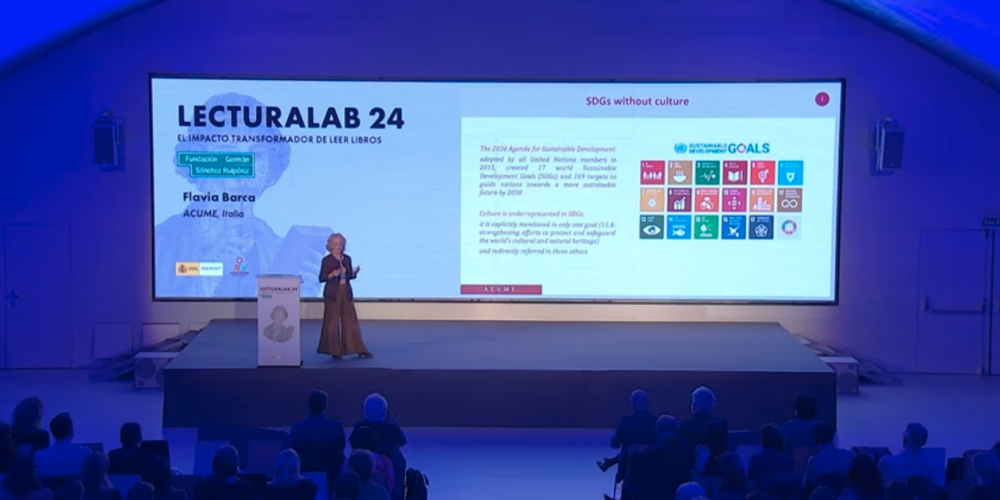
How can books and reading contribute to a more sustainable future? In this LecturaLab 2024 presentation, cultural policy expert Flavia Barca argues that reading is one of society’s most powerful tools for building knowledge, capabilities and cognitive capital. Despite this transformative potential, culture—and books in particular—remains largely absent from the United Nations’ 2030 Agenda and its 17 Sustainable Development Goals.
Barca presents new research conducted with the European Commission’s Joint Research Centre into the relationship between culture and local development. Existing international frameworks contain indicators covering areas such as cultural heritage, museums, education, participation and the creative industries. However, the availability, purchase and reading of books are almost entirely missing, including from UNESCO’s extensive Culture|2030 Indicators framework.
To address this gap, the researchers assembled 43 cultural indicators across four areas: economy; diversity, inclusion and participation; environment and well-being; and education, knowledge and skills. From these, they selected ten indicators for potential pilot testing at the local level. The proposed measures include book purchasing, library visits and online cultural participation, alongside indicators concerning cultural infrastructure, heritage, education and climate resilience.
Barca concludes that access to books and reading should be recognised as an essential driver of ecological and social transformation. Reliable indicators could help governments compare regions, monitor physical and digital reading trends and design more effective cultural policies. Her presentation calls on academics, publishers and policymakers to place books and reading at the centre of the sustainable-development debate.