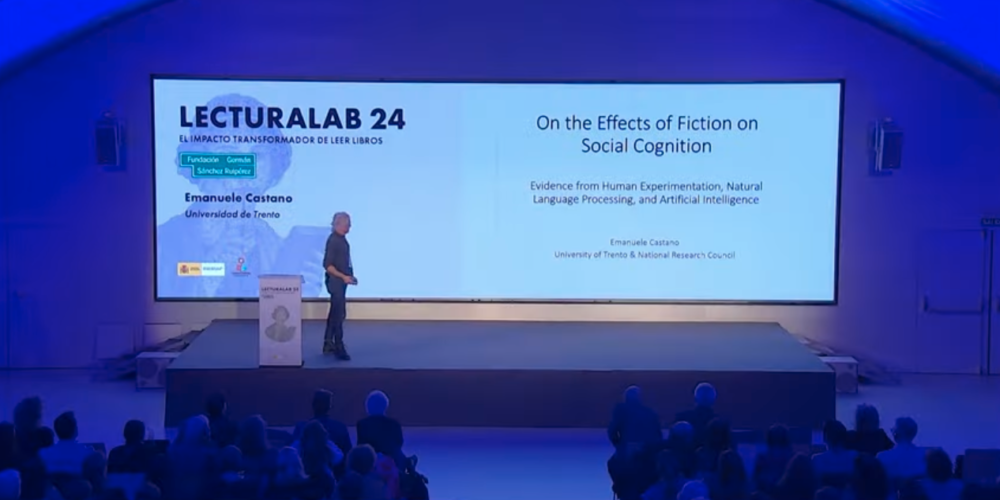
How does reading fiction affect the way we understand other people and society? In this LecturaLab 2024 presentation, cognitive scientist Emanuele Castano examines the relationship between narrative fiction and social cognition—the mental processes through which people interpret emotions, intentions, relationships and social events. Drawing on experimental research, he considers storytelling not simply as entertainment, but as a fundamental part of human social development.
Castano focuses particularly on “theory of mind”: our capacity to represent and interpret the mental states of others. Research suggests that reading literary fiction can improve performance in tasks that measure this ability. Unlike popular fiction, which often relies on familiar plots, recognisable character types and established conventions, literary fiction tends to present complex, unpredictable characters whose motives and emotions require readers to make their own inferences.
The presentation also connects literary reading to dispositions that matter in democratic societies. Castano’s research associates greater exposure to literary fiction with lower psychological essentialism—the belief that people possess fixed and unchanging characteristics—and greater attributional complexity, or the willingness to recognise multiple explanations for human behaviour and social events. Computational analysis further indicates that literary fiction uses more complex language, conveys emotions less explicitly and follows less predictable narrative patterns.
Castano does not argue that literary fiction should replace popular storytelling. Popular narratives can reinforce shared identities and strengthen social cohesion, while literary works challenge familiar assumptions and create space for uncertainty, reflection and change. A healthy society needs both forces. Because commercially successful popular culture already thrives in the market, he concludes that public and institutional support for literary fiction, theatre and independent film remains essential.