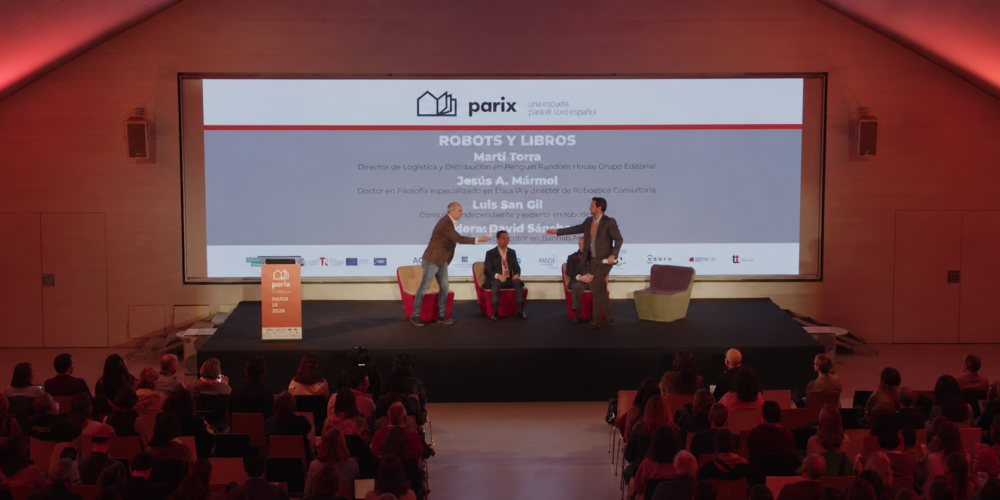
At PARIX IA 2026, held in Madrid on 18 March 2026, Martí Torra, Jesús A. Mármol and Luis San Gil examine the present and future relationship between robotics and the book industry. Moderated by David Sánchez, the session begins with Penguin Random House’s automated distribution centre, opened in 2024. Its Exotec and Locus systems use robots to retrieve books, prepare orders, optimise routes and anticipate maintenance requirements.
Behind these machines is what Sánchez describes as “Decision AI”: predictive models, mathematical optimisation and simulations that solve complex operational problems. These systems can improve purchasing, stock positioning, order grouping, picking routes, palletisation, loading docks and transport. They can also model alternative scenarios before a company invests in additional warehouse space, production lines or robots. The objective is collaboration between people and machines rather than complete worker replacement.
San Gil expands the discussion from industrial robots to humanoids. Robotics already supports book production, storage, conservation, library inventories and large-scale digitisation. Future robots could become library assistants, cultural hosts or reading companions, helping readers discover books and supporting children during reading. Because these machines will increasingly interact with people, the publishing community must actively define their role instead of allowing technology companies and market forces to determine it alone.
Mármol focuses on the ethical consequences of embodied AI. As artificial intelligence increasingly controls information and generates content, society risks treating it as an unquestionable source of truth while weakening human cognitive abilities. He proposes translating abstract moral principles into measurable technical criteria that can be evaluated algorithmically. The speakers ultimately argue for informed adoption with continuous human oversight, suggesting that authors and publishers can help shape the cultural knowledge, values and behaviour incorporated into future robots.
Original title: Robots y libros