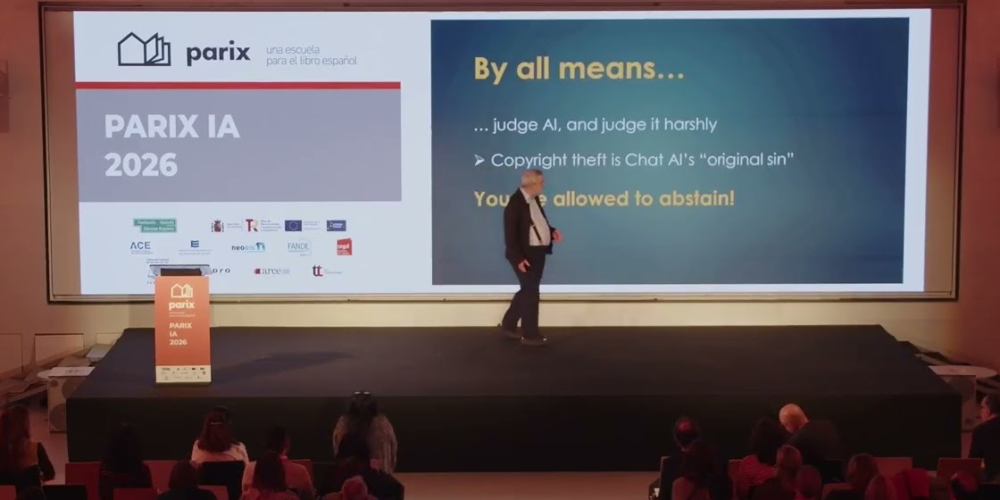
At PARIX IA 2026, held in Madrid on 18 March 2026, publishing technology analyst and author Thad McIlroy examines the complicated relationship between artificial intelligence, copyright and content licensing. McIlroy, founder of The Future of Publishing, explains how his own understanding changed after generative AI reached a decisive stage of development in 2022.
He addresses widespread concerns that AI companies have stolen copyrighted books or will overwhelm the market with low-quality automated content. While models can sometimes reproduce memorised material, McIlroy argues that this is not their normal behaviour. He also distinguishes between legal disputes concerning the use of copyrighted works for training and cases involving material obtained from unauthorised or pirated sources.
Licensing remains a major opportunity, but books present different challenges from journalism and other frequently updated information. McIlroy notes that books represent less than 0.01% of the world’s available information, limiting their immediate importance for training general-purpose models. Their value may instead lie in providing reliable, specialised and carefully edited knowledge that AI systems cannot obtain from less authoritative sources.
Retrieval-Augmented Generation could provide a practical bridge between publishers and AI developers. Through RAG, models can consult licensed collections when answering questions, filling gaps with trustworthy material while allowing publishers and authors to retain greater control over its use. McIlroy encourages publishers to judge AI critically and defend copyright, but also to recognise the strategic value of their data. The industry’s opportunity is to move beyond managing information and transform its assets into structured knowledge—and ultimately wisdom—that AI services and their users will value.
Original title: El panorama de las licencias de contenidos para la IA: retos y oportunidades para los editores