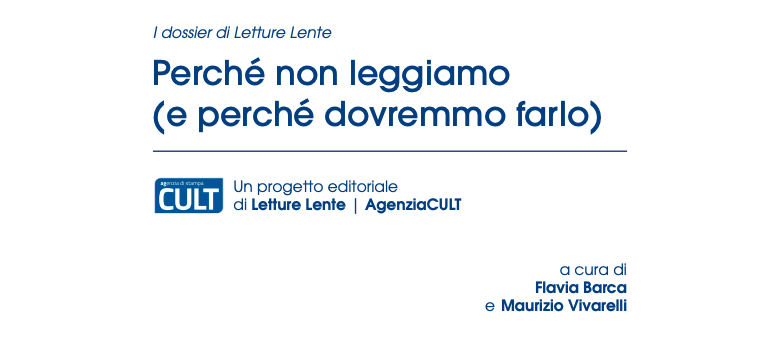
Why We Don’t Read (and Why We Should) is a comprehensive Italian report published by AgenziaCULT’s Letture Lente initiative, exploring the relationship between reading, human development, and public policy. Edited by Flavia Barca and Maurizio Vivarelli, the volume brings together 26 essays from experts in library science, social sciences, economics, media studies, and reading research.
The report starts from a troubling reality: Italy remains one of Europe’s weakest reading nations. According to the study, only 35.4% of Italian adults read at least one book annually, compared to a European Union average of 52.8%. Reading habits are strongly influenced by education levels, geography, and access to cultural infrastructure, revealing deep and persistent inequalities.
Rather than viewing reading solely as a cultural activity, the authors frame it as a critical component of social and economic development. The report reviews extensive evidence linking reading to cognitive development, critical thinking, empathy, well-being, social participation, and economic resilience. Reading is presented as a form of “invisible infrastructure” that supports democratic citizenship and social cohesion.
A major focus is placed on the role of libraries, schools, bookstores, and community organizations as essential reading infrastructures. The report argues that successful reading policies depend not only on access to books but also on creating environments that foster reading habits and motivation. Libraries, in particular, are described as multifunctional community hubs that contribute to education, social inclusion, health, and lifelong learning.
The study also examines how reading practices are evolving in the digital age. While print remains dominant, digital books and audiobooks are growing, creating a more hybrid reading ecosystem. The authors reject simplistic print-versus-digital debates and instead emphasize the importance of preserving deep reading and sustained attention across formats.
Concluding with a series of policy recommendations, the report calls for stronger investment in reading infrastructure, better data collection, targeted interventions in underserved communities, support for libraries and schools, and the integration of reading into broader social, educational, and development strategies. Its central message is clear: reading should be understood not as a private leisure activity but as a public good and a cornerstone of human development.