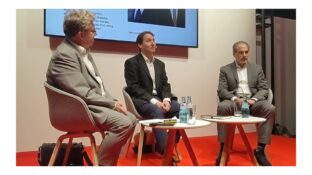
Pablo Langa, CEO and founder of DDT and Partners, moderated in Readmagine 25 a vibrant discussion on the role of technology in education, engaging three industry experts: Alberto Polanco from Santillana Group, Tony Lorin from McGraw Hill International, and Alberto Valero from BQ. The conversation, spanning various perspectives and experiences, explored critical questions about whether education technology (EdTech) serves as an ally or adversary.
The initial challenge addressed by Pablo Langa referred to the description of each of their strategies and the second one was to contrast their respective approaches exemplified by Denmark and South Korea in integrating technology into early childhood education.
Alberto Polanco emphasized EdTech as a crucial ally under specific conditions, highlighting its potential to expand educational access, personalize learning through AI, and enhance teacher training for effective implementation. He acknowledged the contrasting approaches of Denmark and South Korea, where Denmark prioritises holistic student development while South Korea emphasizes academic performance through pervasive technology use.
Tony Lorin expressed unequivocally that technology is an ally in education, empowering educators to engage students effectively. He discussed South Korea’s intensive use of technology from kindergarten, juxtaposing it with concerns about student stress and excessive academic pressure. Lorin’s perspective underscored cultural influences on educational philosophies and practices.
Alberto Valero provided a nuanced view, cautioning against viewing technology as inherently good or bad. He argued that technology should serve educational goals rather than overshadow them, advocating for thoughtful integration aligned with pedagogical needs. Valero critiqued superficial digitalization efforts, suggesting a reflective approach to ensure technology enhances learning rather than merely substituting traditional methods.
During the first part of the session the relevant issues were:
- Technology as an ally: all participants agreed that when used purposefully and with careful planning, technology can significantly enhance educational outcomes. It enables personalised learning, improves access to educational resources, and supports teacher effectiveness through data-driven insights and adaptive learning programs.
- Cultural and philosophical differences: the discussion on Denmark and South Korea highlighted divergent approaches to technology in education. Denmark’s focus on holistic development contrasts sharply with South Korea’s emphasis on academic achievement through technology-enabled intensive learning environments, reflecting broader cultural values and educational priorities.
- Challenges and caution: despite its benefits, concerns about the overreliance on technology and its potential negative impacts on student well-being and educational quality were evident. Participants stressed the importance of maintaining a balance and ensuring that technological integration aligns with educational goals rather than becoming an end in itself.
- Future directions: The conversation concluded with a call for strategic planning and thoughtful implementation of technology in education. It emphasized the need for ongoing evaluation and adaptation of EdTech tools to meet evolving educational needs and address the challenges posed by varying cultural contexts.
Throughout the remainder of the session, various decision-making elements regarding the educational publishing landscape for 2025 and the outlook for the years to come were discussed in a very interesting discussion that can be followed in this video.
Alberto Polanco is currently the CEO of Grupo Santillana in Mexico. With over 30 years of experience in the publishing industry, he has served as CEO of Santillana in Bolivia, Argentina, Central America, and Colombia for the last 25 years. As one of Grupo Santillana’s drivers of digital transformation, he participated in developing, implementing, and consolidating the group’s subscription models in Latin America, such as UNOi, Compartir, and Richmond Solution. He is currently a board member of CANIEM (Mexican Chamber of the Publishing Industry). Alberto holds a degree in Business Administration from Saint Louis University
(Missouri). He also completed the Advanced Management Development Program from the Prisa Group (PADD).
Alberto studied Industrial Engineering at the Polytechnic University of Madrid. He later completed three years of philosophical studies before beginning a PhD in Computer and Systems Engineering at Sapienza University of Rome, where he earned his doctorate in 2009.
After completing his PhD, he focused on research and teaching at Carlos III University of Madrid, lecturing in several undergraduate programs at the School of Engineering.
In 2012, he joined BitBrain Technologies as Head of Technology. In 2013, he was hired by BQ Educación, a company specialized in EdTech. Since then, he has been the Director of BQ Educación, where he also leads the R&D department in Artificial Intelligence. Currently, BQ is focused on developing AI models to support learning processes and press houses.
While he has been teaching part-time at Nebrija University since 2018—where he gives programming courses in the Computer Engineering degree program—his main professional focus remains on his work at BQ.
Pablo is the Founder & Managing Partner of EDT&Partners, a global consulting firm dedicated to advancing education through innovation and the effective use of technology.
When not traveling, Pablo is based in Valencia, where he enjoys learning from his 40+ teammates and consultants spread across 16 countries.
He is passionate about scaling established business operations and launching new initiatives, especially projects related to education technology that impact individuals, communities, and organizations.
As one of Blackboard’s early international hires, Pablo led the Mobile Learning division globally. More recently, as Vice President of Business Development at The Financial Times & IE Business School Corporate Learning Alliance (Headspring), he was responsible for building long-term value through strategic relationships, new market development, and customer success.
Pablo brings a unique blend of experience working with well-established education leaders and early-stage ventures. He has also founded and helped grow impactful platforms such as ZeroAcoso.org, the first dedicated technology solution for bullying prevention and support.
Tony Lorin was named President, International, in May 2020. He is responsible for McGraw Hill’s business serving the K–12 and Higher Education markets outside of the U.S., distributing McGraw Hill products in 75+ languages to more than 100 countries across the Americas, Asia-Pacific, Europe, India and the Middle East. Before being named the group’s President, Tony served as Chief Operating Officer and Chief Financial Officer for McGraw Hill International, and as Global Head of Financial Planning & Analysis before that. Throughout his career, Tony has spent significant time living and working in Asia, Australia and Europe and is well-travelled in Latin America, India and Canada – all important markets for McGraw Hill.
Before joining McGraw Hill Education in 2012 as CFO for Asia-Pacific, Tony held various positions at The McGraw Hill Companies in Paris, Sydney and Singapore. He began his career as an Auditor at PwC.
Tony holds a Master’s degree in Finance/Audit from Tours Business School in France. He is based in London.