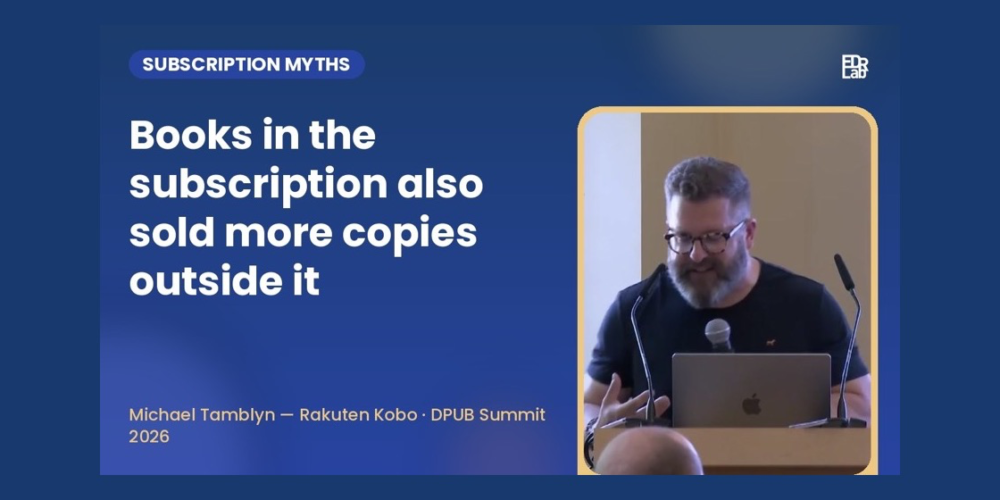
Michael Tamblyn delivered this presentation at the Digital Publishing Summit in Prague on 8–9 June 2026. He explains how Kobo developed its all-you-can-read subscription service while managing the risk that it might undermine the company’s successful single-copy ebook business.
Kobo initially tested the model in the Netherlands, working with local retail partner bol.com and a publishing market already interested in alternatives to piracy and platform dependence. Contrary to Kobo’s fears, subscriptions did not reduce individual book sales. They attracted new customers, including readers who had never previously bought an ebook from Kobo, and expanded the overall market.
Subscription readers start and finish considerably more books, spend more time reading and explore less familiar authors, genres and backlist titles. Removing the financial risk attached to choosing an individual book encourages experimentation. This particularly benefits debut authors, independent writers and smaller publishers that lack large marketing budgets.
Tamblyn presents subscription as an additional stage in a book’s commercial life rather than a replacement for conventional sales. Revenue is distributed according to actual reading activity, while inclusion in Kobo Plus can strengthen recommendations and improve single-copy sales. His central conclusion is that disruption need not mean destruction when experimentation is controlled, measured and designed around readers.