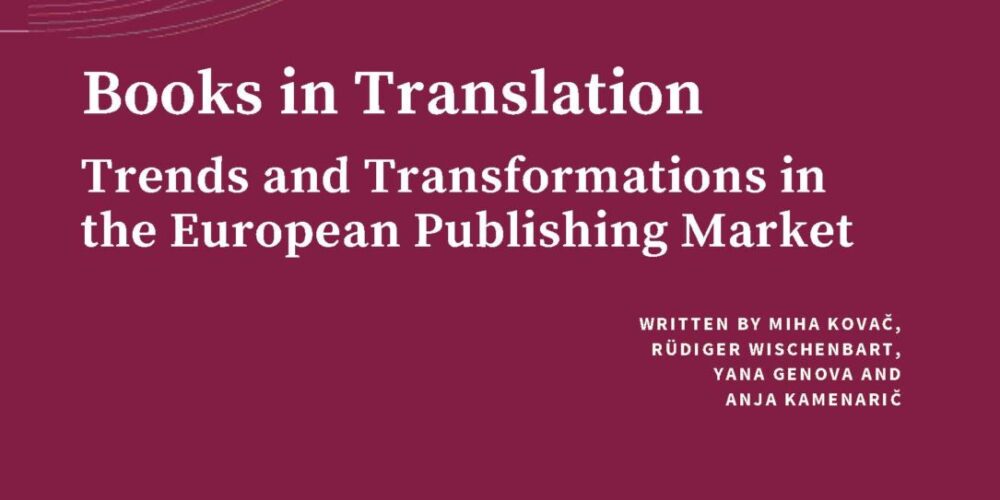
The report Books in Translation offers a comprehensive, data-driven analysis of book translations across Europe, examining how literary works move between languages, markets, and cultures. At a time when Europe’s cultural diversity and democratic resilience are increasingly tied to cross-border exchange, the report provides timely and important insight into the role of translation as a cornerstone of the European book ecosystem and as a key instrument of cultural policy.
Drawing on quantitative data, qualitative market analysis, and country-level case studies, the report deepens understanding of how translations shape readerships, publishing strategies, and cultural flows across Europe — and how these dynamics are evolving under conditions of economic pressure, digital transformation, and geopolitical change.
Taking a Europe-wide perspective, Books in Translation combines statistical evidence with market intelligence from national book industries and national libraries. Its scope includes translation flows between European languages, as well as from non-European source languages into European markets; the role of English as a dominant source language alongside regional and smaller languages; structural differences between large and small book markets; the impact of subsidies, institutional frameworks, and public funding on translation activity; and the strategic position of translations within publishers’ catalogues.
Rather than treating translation as a marginal or purely cultural phenomenon, the report positions it as a structural component of Europe’s book economy — one that influences competitiveness, the discoverability of authors, and long-term cultural exchange.
The analysis identifies several overarching trends shaping European translation markets. First, translation volumes are becoming increasingly concentrated. While the total number of translated titles remains substantial, a growing share is accounted for by English-language originals, reflecting both global market power and rising costs for acquiring translation rights. Second, economic pressure on publishers has intensified. Declining unit sales in many markets, combined with rising production and translation costs, are narrowing the financial margins for translation projects, especially for smaller publishers. Third, regional translation ecosystems matter. Countries with strong public support schemes and long-standing traditions of cultural exchange show more diverse language portfolios, whereas markets with weaker institutional support tend to rely more heavily on commercially dominant source languages. Finally, the report highlights a persistent data gap: comparable, harmonised statistics on translations are often incomplete or fragmented, making evidence-based decision-making more difficult for both industry actors and policymakers.
One of the report’s central findings is that translation must be understood both as a market activity and as a public good. Commercial logic alone is not sufficient to sustain linguistic diversity, particularly for works from smaller languages or less commercially dominant regions. Public support mechanisms — including translation grants, publisher subsidies, and international cooperation programmes — emerge as decisive factors in maintaining diversity and ensuring long-term cultural circulation.
The report also underscores that translations are investments in cultural infrastructure. They build bridges between readerships, enable authors to travel beyond national boundaries, and contribute to Europe’s shared cultural space.
For publishers, editors, and literary agents, the findings offer strategic guidance on how translation choices interact with market size, rights costs, and catalogue development. Understanding broader European trends allows professionals to position their lists more effectively and to identify opportunities for cross-border cooperation. For policymakers and cultural institutions, the report provides an evidence-based foundation for assessing existing support schemes and designing future policies. Translation emerges as a powerful tool for sustaining cultural diversity, strengthening smaller markets, and reinforcing Europe’s cultural cohesion.
At a time when cultural exchange faces economic, political, and technological challenges, Books in Translation makes a clear case: supporting translation is essential to maintaining a vibrant, pluralistic European book landscape — and to ensuring that Europe continues to speak to itself, and to the world, in many voices.
Books in Translation has been authored by Miha Kovač, Professor of Publishing Studies at the University of Ljubljana (Slovenia), book market researcher Rüdiger Wischenbart (Austria), cultural manager and researcher Yana Genova (Bulgaria), and Anja Kamenarič, PhD researcher at the University of Ljubljana (Slovenia).
The report is available as a free download.
 Books in Translation report (PDF)